

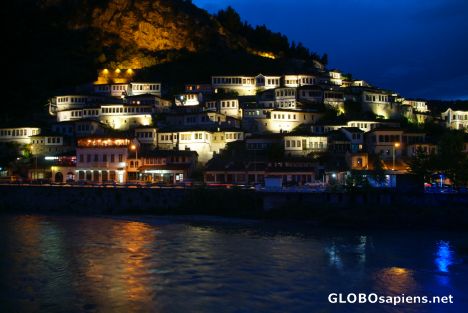

Berat is a city located in south-central Albania and the capital of both the District of Berat and the larger County of Berat. As of 2009, the city has an estimated population of around 71,000[1] people. In July 2008, the old town (Mangalem district) was inscribed on the UNESCO World Heritage List.Berat lies on the right bank of the river Osum, a short distance from the point where it is joined by the Molisht river. It has a wealth of beautiful buildings of high architectural and historical interest. The pine forests above the city, on the slopes of the towering Tomorrmountains, provide a backdrop of appropriate grandeur. The Osumi river has cut a 915-metre deep gorge through the limestone rock on the west side of the valley to form a precipitous natural fortress, around which the town was built on several river terraces.
According to an Albanian legend, the Tomorr mountain was originally a giant, who fought with another giant, called Shpirag over a young woman. They killed each other and the girl drowned in her tears, which then became the Osum river.
The town is still renowned for its historic architecture and scenic beauty and is known as the "Town of a Thousand Windows", due to the many large windows of the old decorated houses overlooking the town.
It is unclear whether it really means "Thousand" (një mijë) or "One over Another" (një mbi një) windows. Indeed, the quarter is built in a very steep place and windows seem to be one over another. Similar views can be seen in Gjirokastër, as well as Catanzaro in Italy, where an Albanian minority once lived.
The Citadel overlooks the river and the modern city as well as the old Christian quarter across the river. It is a well preserved area containing narrow streets, Turkish houses and Orthodox churches.
Modern Berat consists of three parts divided by the Osum River: Gorica ("little mountain" in Old Church Slavonic), Mangalem and Kalaja, the latter being a residential quarter within the old Byzantine citadel that overlooks the town. The town also has a 15th-century mosque and a number of churches of the Albanian Orthodox Church, whose autocephaly was proclaimed there in 1922. Several of the churches house works by the renowned 16th century painter Onufri.

No comments:
Post a Comment